I. Introduction
If you work in construction machinery, invest in equipment, or plan to buy machines, the global excavator market data for 2026 is worth your attention. After several years of adjustment, the global excavator market showed clear recovery in 2025. The Chinese market has bottomed out, and overseas markets are undergoing a structural shift.
This article uses industry data and customs export figures from early 2026 to analyze the global excavator market – with a focus on small excavators – covering growth regions, popular machine types, and why Africa and Latin America have become the main export destinations.
II. Global Pattern: Growth Engine Has Shifted
Global excavator volume recovered to about 520,000 units in 2025 and will stay at high levels in coming years. China, Europe, and North America together account for 70% of demand, but growth drivers are diverging.
China (35% share): Market bottoming out, sales recovering.
Europe (19%): High interest rates and construction costs causing decline; 2025 sales expected to drop 2%.
North America (16%): Cyclical decline, tariffs may worsen the trend.
Key change: Europe and the US are slowing down. In early 2026, Chinese exports to Africa grew 77%, to Latin America 71.5% – well above global average. The growth engine has shifted from the West to emerging markets.
III. Developed Markets: Mini Excavators Dominate
In Europe, mini excavator market share for small machines is 84%-86% ; in North America it exceeds 80%. Developed countries have completed most major infrastructure. Municipal repairs, landscaping, and agricultural projects are now the main applications. High labor costs and the flexibility of small excavators make them the fastest-selling category.
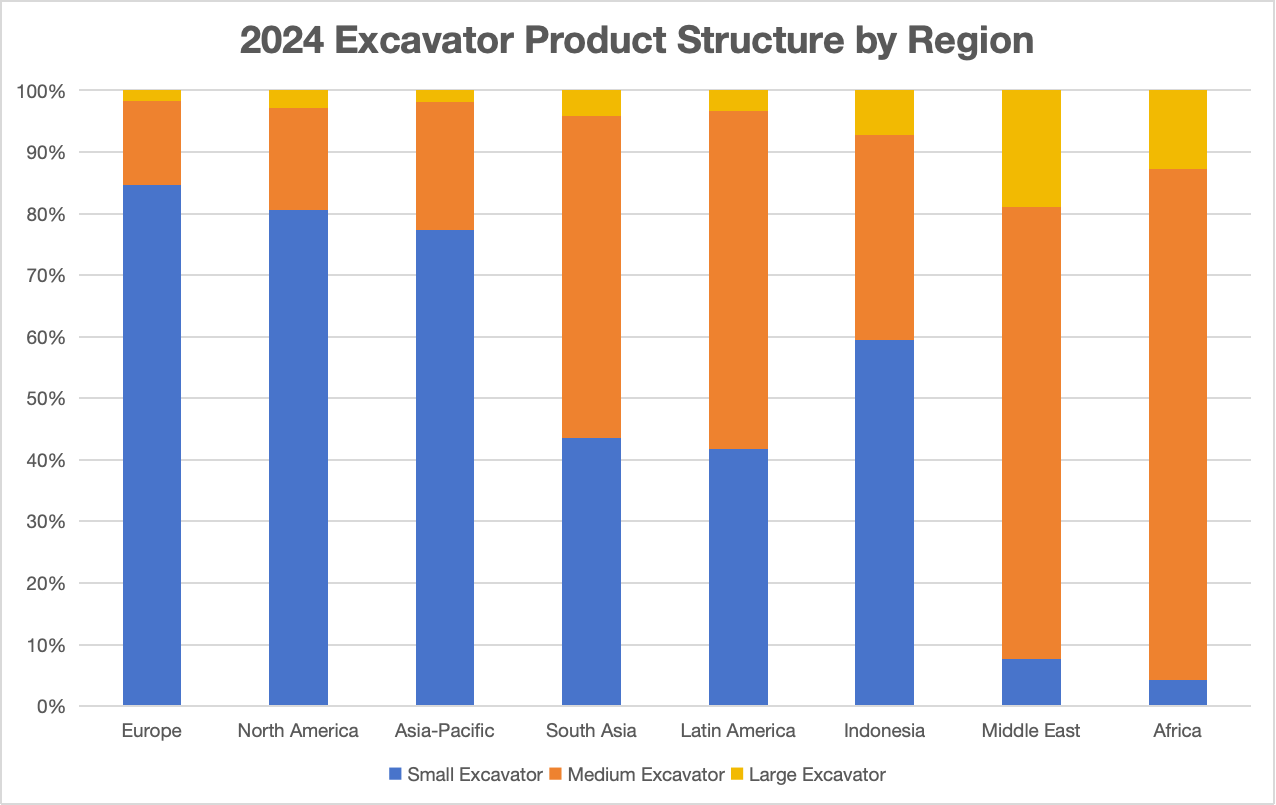
However, barriers are rising. EU anti-dumping duties on Chinese small excavators range from 0%-14.2% , with possible increases. The CBAM carbon tax adds about €80 per ton of steel. Price advantage alone is no longer enough.
For sellers targeting Europe and the US: shift to electric models, meet Stage V emission rules, and build local service networks.
IV. Latin America: 71.5% Growth
In early 2026, Chinese exports to Latin America grew 71.49%. Brazil took 881 units in March 2026 alone – evidence of a growing mini excavator market in the region.
Three drivers: (1) Brazil’s infrastructure investment. (2) Agricultural demand for small excavators. (3) Mining and municipal projects in Mexico, Chile, Peru.
Latin America is price-sensitive and early in electrification, meaning the mini excavator market has room to grow. Local service networks build long-term advantages.
V. Middle East: Dual-Engine Drive
The GCC compact equipment market was 4.8billionin2025∗∗,growingat∗∗5.494.8billionin2025∗∗,growingat∗∗5.497.8 billion by 2034 – a major opportunity for any excavator manufacturer.
Three drivers: (1) Saudi Vision 2030 and UAE 2040 Plan. (2) Post-conflict reconstruction. (3) Oil and gas investment.
Entry barriers: SASO certification, local buying preferences. Quality and after-sales service are essential for any excavator manufacturer.
VI. Africa: Fastest-Growing Market
In early 2026, Chinese exports to Africa grew 65.83%. In March alone, China exported 374 units to Nigeria.
Roads, railways, ports, and power stations are being built across Africa, with funding from African Development Bank and World Bank.
Challenges: political volatility, limited payment capacity. Localized “equipment + service” models are essential for any Chinese excavator manufacturer.
VII. Chinese Mini Excavators: Price, Electrification, Service
Chinese brands have moved from pure price competition to a three-dimensional advantage.
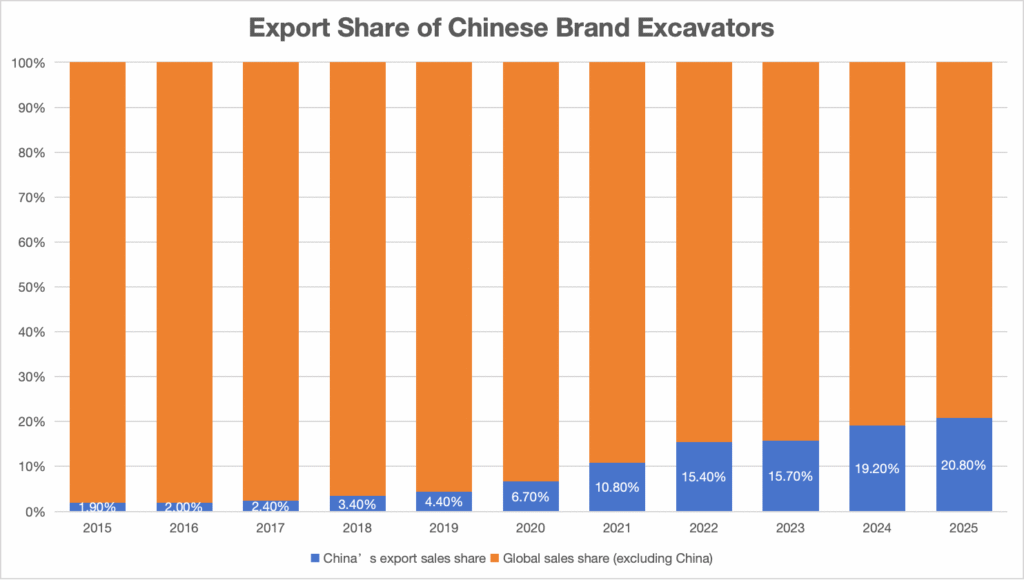
Price & delivery: Chinese mini excavators cost 60%-80% of Western/Japanese rivals, with lead times 15-20 days shorter – a critical edge in the 2026 mini excavator segment. Chinese brands held 35% of the global mini excavator market in 2025, second only to Japan’s 32%.
2026 mini excavator demand is shaped by electrification. Lipai Machinery holds 18% of the EU/US market. Sany has over 15% of the European electric mini excavator market.
Service networks: Local service centers for “same-day response, next-day on-site service.”
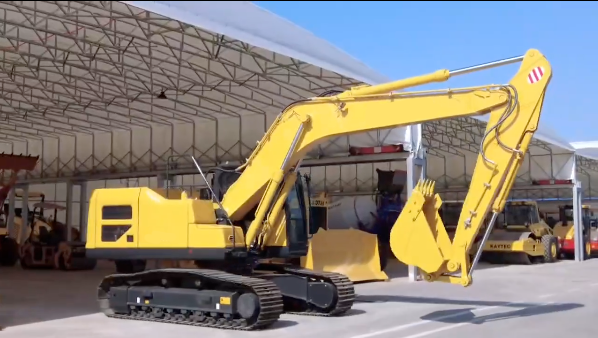
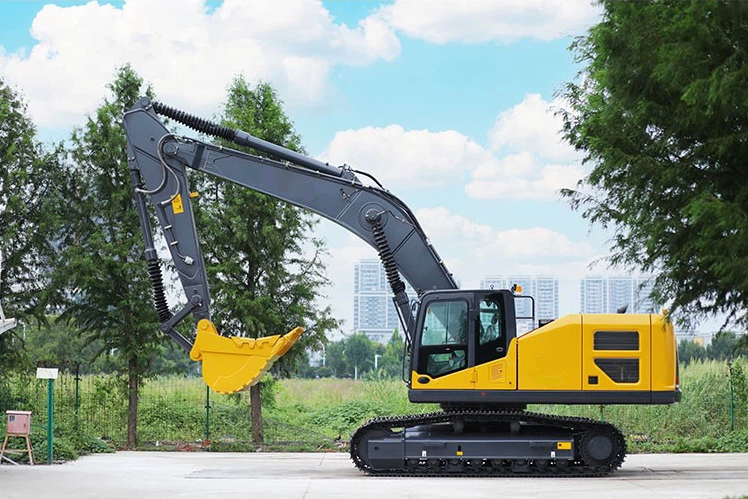
If you need a reliable supplier, here is our recommendation: Qhmach. We are a Chinese excavator manufacturer with over 20 years of experience. We offer 1.5 to 36-ton excavators. Our mini excavators deliver high cost performance and flexibility. Our products reach 60+ countries, supported by 50+ overseas agents.
VIII. 2026 Forecasts: China Growth & Export Surge
The 2026 mini excavator segment will drive overall dynamics.
China: Sales expected to grow 10% in 2026, continuing 19% growth from 2025. Small excavators up 9% , medium-large up over 10%. Jan-Feb 2026 exports reached 57,614 units, up 52.33%. Full-year 2026 mini excavator exports expected to exceed 110,000 units, up 20% , with electrification penetration at 15%.
International (excluding China): Global sales around 400,000 units. Export share: Africa 26.22% , Latin America 11.78% – up 5.25 and 2.67 points – while Europe (18.06%) and North America (4.20%) declined. This shift is structural.
IX. Summary
The global excavator market in 2026 shows a clear structural picture. China to grow 10% , mini excavators stable. Export focus has shifted from the West to Africa, Latin America, and the Middle East – Africa up 77% , Latin America up 71.5% . Chinese mini excavators compete on price (60%-80% of rivals ) and faster delivery. Electrification and local service will decide winners. Three themes – steady China growth, 2026 mini excavator exports, and emerging markets – are the core path to success.